
Three Big Ideas #62
Building blockers, the Catapult conundrum and administrative AI adoption


🏗️ Philip Salter, Founder
Since 1970, productivity across most of the American economy has roughly doubled. In construction, it has fallen by around 40%. A new VoxEU column by Dongkeun Choi and Munseob Lee unpacks why.
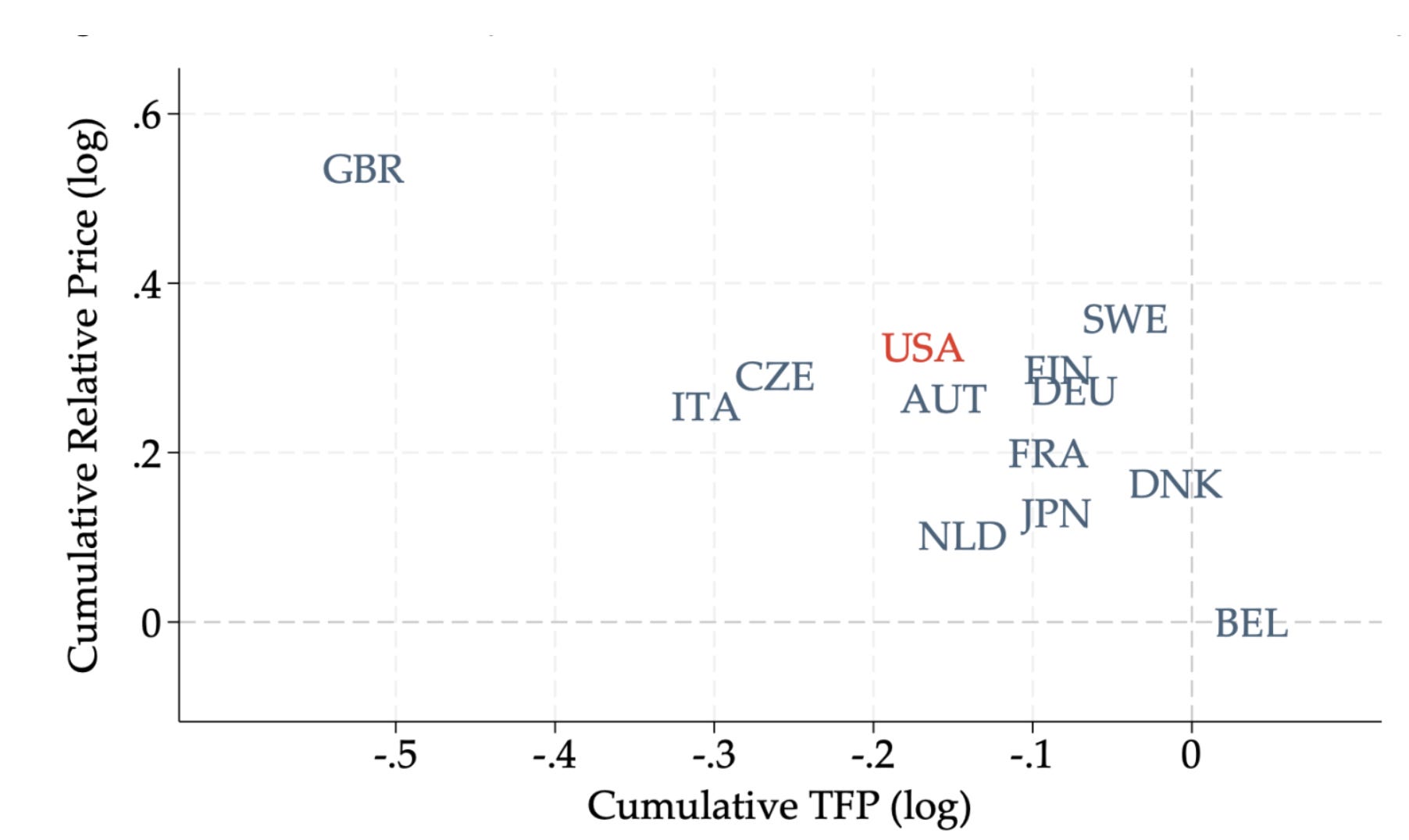
The fall in the price of equipment — computers, machines, instruments — has been one of the great engines of the post-war economy, adding around 1.3 percentage points a year to growth in output per person. But structures have moved the other way. The relative price of buildings in the US is now 80% higher than in 1970, and that rise claws back almost two-fifths of the gain from cheaper machines. The net contribution of falling capital-goods prices is therefore closer to 0.8 points than 1.3.
“About three-quarters of the drag runs through standard capital deepening. When structures are expensive, firms accumulate less of them, and production slows accordingly. The remainder operates through innovation. Laboratories, offices, and pilot plants are themselves structures. Stagnant productivity in construction raises the cost of doing science.”
This is not an American curiosity. Choi and Lee examine thirteen advanced economies, and all but Belgium sit in the same troubling quadrant: construction prices up, construction productivity down. Across the entire sample, the UK records both the largest fall in construction productivity and the steepest rise in the relative price of building.
Why has construction forgotten how to build? The leading suspect is regulation. Hilber and Vermeulen show that the restrictiveness of the UK’s planning system, more than any physical shortage of land, drives the long-run rise in house prices; D’Amico and co-authors tie America’s construction-productivity stagnation directly to land-use rules. A planning regime that makes every project bespoke, contested and slow has meant construction is one of the few industries that never industrialised — it never achieved the scale economies and standardisation that lifted output almost everywhere else.
This resembles Baumol’s cost disease. When productivity stalls in one sector but the rest of the economy still needs its output, the relative price rises and everyone else pays for it. What makes construction unusual is that there is no way to route around it: the economy cannot make do with fewer hospitals, fewer fabs or — increasingly — fewer data centres. The cost of standing still in construction shows up everywhere.
As is often argued, restrictive planning acts as a tax on housebuilding. But it has also held back innovation in the construction industry. Alongside planning reform, we need to look deeper at what’s made us less efficient at building.
🏹 Mann Virdee, Head of Science and Technology
When I was invited to give evidence before the Business and Trade Select Committee on industrial strategy, I emphasised three main points. First, a few outliers skew the statistics on British science. Once they’re removed, British science isn’t quite so ‘world-leading’. Second, the state can play an important role in procurement, such as through Advanced Market Commitments, and in de-risking the journey to market for entrepreneurs. Third, I offered some historical background on how Silicon Valley came to be the world’s pre-eminent hub for innovation and entrepreneurship.
But one question from the committee stumped me slightly: how effective is the Catapult Network? It’s a part of the UK’s R&D ecosystem I hadn’t really looked into in detail, although my overwhelming sense was that the Catapults were usually an afterthought in conversations about innovation and commercialisation I’d been part of. I thought it best to say nothing rather than pretending I had a more considered response.
The Catapult Network was created in 2011 after a report by Hermann Hauser that proposed an elite network of centres to help translate breakthrough scientific discoveries into commercial industries. It was modelled on 12 international comparators, including Germany’s Fraunhofer institutes.
There have been a series of reviews with mixed findings. A 2014 review called for doubling down on the approach, saying that it was mirroring international comparators, and recommended expansion. A 2017 review by Ernst & Young found that the centres were not being properly managed and that they had no common purpose statement. A 2021 government review recommended reviewing the Catapults less often, but it also found that the High Value Manufacturing Catapult alone had generated 75% of all the Catapults’ income the previous year, showing a highly uneven impact.
Against this background, there are reports that ministers are lining up another review of the Catapults to assess their value and impact after concerns that some have failed to support regional growth and help build national champions. It’s rumoured that streamlining and job cuts may be on the cards.
I recently wrote about an OECD report on the ‘valley of death’ between Britain’s strong support for research up to prototype and its thin support for demonstration, customer validation and early market entry. That report’s proposed solution was to expand the commercialisation role of the Catapults.
So the function clearly matters. The gap the Catapults were built to fill is, if anything, widening. The question remains whether these particular institutions are still the right vehicle for the job.
One approach is to keep tinkering and topping up funding, hoping that some future permutation works. The other is to know when to call it a day and build something new with a sharper remit, explicitly tied to growth and closing the demonstration-to-market gap. Founders I’ve spoken to lean towards the latter. But before we can choose well between these, we need an honest diagnosis of why the Catapults are underperforming — and what, concretely, we would do differently.
📈 Rafi Pollack-Joyce, Policy Analyst, Public First
Tony Blair’s intervention last week has put AI in the public sector at the heart of the fledgling Labour leadership debate. But is he right that governments can harness the technology to deliver more with less?
Earlier this year, Public First surveyed 3,335 public sector workers across ten countries. The headline finding is striking. AI is everywhere. Around three-quarters of public servants now use it, and most started in the past year. That probably makes AI the fastest-adopted technology the public sector has ever seen. But there’s a big difference between using a tool and changing how the government works.
The countries doing best aren’t simply the ones with the biggest AI sectors. They’re the ones that have made AI feel usable inside government. That means clear permission, decent training, approved tools, and a way for good experiments to become normal practice.
Singapore is the clearest example. Its advantage isn’t magic technology. It’s that public servants have more of the scaffolding around them: guidance, tools, training and institutional support. For example, Singapore is twice as likely as the UK or US to conduct mandatory training for employees. The results are clear: compared with the UK and US, Singaporean public sector workers are more than twice as likely to use AI daily, to be using it for complex tasks, and to think the public sector in their country overall is using it effectively.
The UK and US have a more awkward problem. Both are AI leaders in the obvious sense, with companies, researchers and policy attention. But inside government, use is patchier. People are interested, and often already experimenting, but many still don’t have clear guidance on what they’re allowed to do or how to move beyond low-risk tasks. While just over half of public servants in the UK and US feel confident using AI tools, that rises to 85% in Singapore.
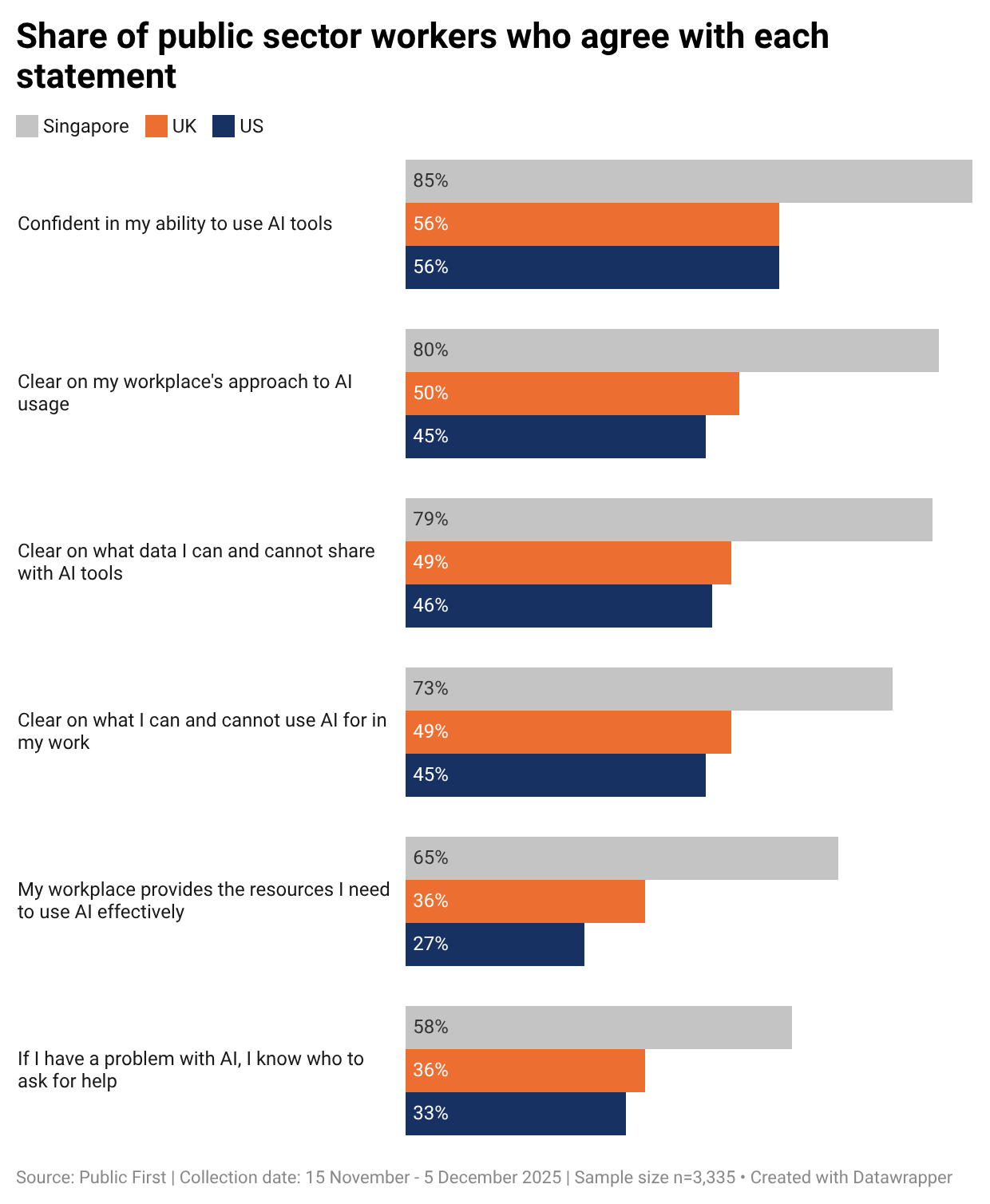
That matters because unclear permission doesn’t necessarily stop AI use. It just makes it messier. People experiment on personal accounts, stick to shallow use cases, or run pilots that never really scale.
Ultimately, this is fixable. The hard part isn’t persuading public servants that AI matters, it’s building the basic machinery around it: procurement, guidance, training, data access and routes to scale.
Blair is right that AI could change the state. But the first test is more mundane: whether the government can manage the adoption that’s already happening.
 | A guest post by
|