
Three Big Ideas #67
Local lending, medicine's missing markets and capital constraints


🏦 Mann Virdee, Head of Science and Technology
Britain had a regional banking system and then, after a century of mergers and acquisitions, didn’t. Almost exactly 190 years ago, Midland Bank was founded in Birmingham. As it grew, it acquired other local banks, such as the Union Bank of Birmingham in 1883, and moved its head office to London in 1891. By the 1930s, Midland was, by some measures, the largest deposit bank in the world. It’s now part of HSBC. Many other regional banks followed the same path. The Manchester and Liverpool District Bank, for example, was acquired by National Provincial Bank, which later became NatWest.
While Germany still has its Sparkassen-Finanzgruppe (a network of local, publicly owned savings banks), we have branch networks whose credit decisions are often taken far away from the borrower.
That’s the broad context for two independent research papers on the geography of finance, which have just been published by the Financial Conduct Authority.
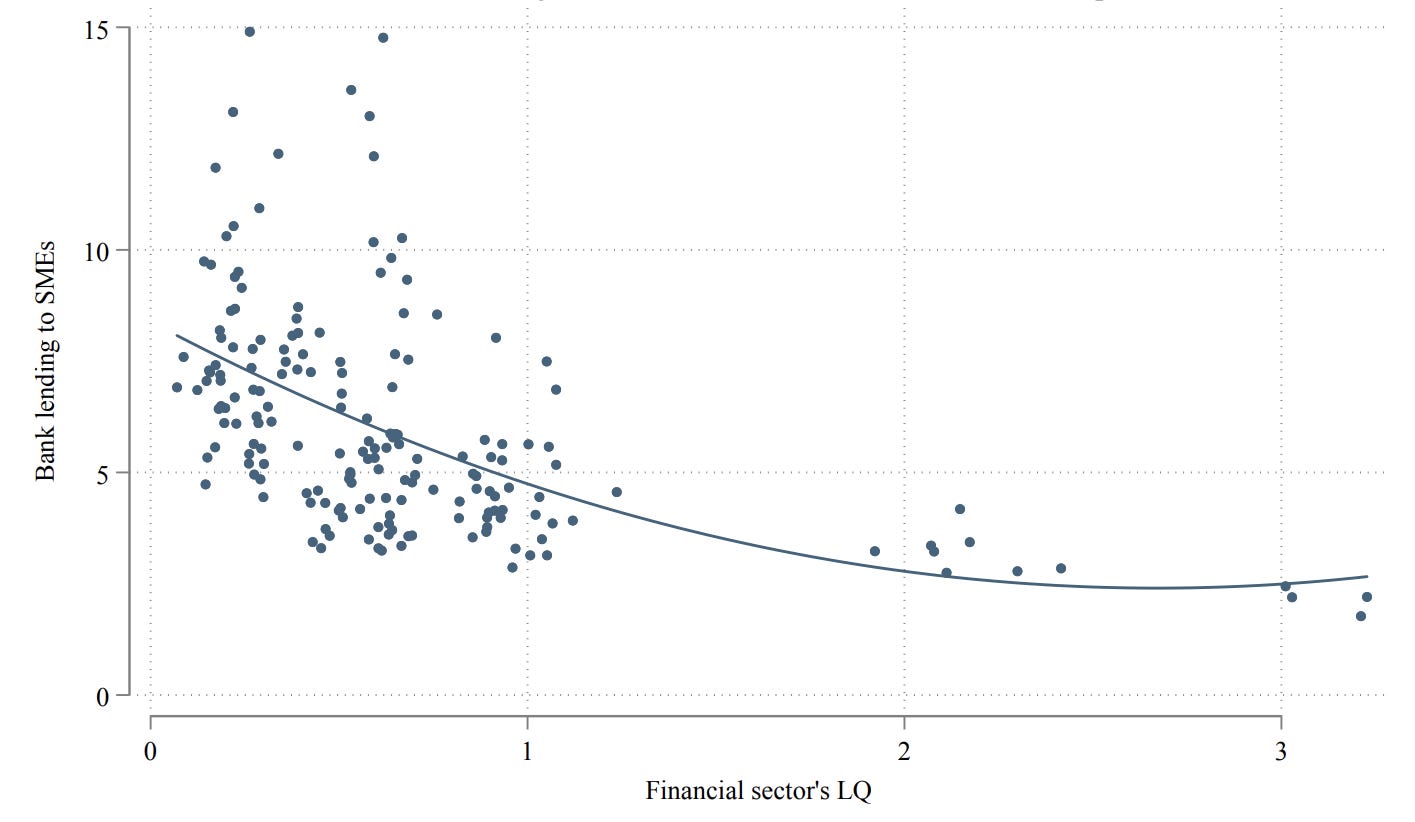
One of these papers found no evidence of a positive correlation between the overall size of a region’s financial sector and how much its smaller firms can borrow. That is, deeper capital markets don’t necessarily flow through to founders.
Instead, the authors argue, what matters is the composition rather than the scale. Their research found that lending to SMEs correlates consistently with regional growth. Broader financial expansion helps only up to a point, beyond which the relationship turns negative.
This means that geography, which digitalisation was supposed to have rendered unimportant, persists. It’s proximity that still shapes both small-business lending and whether larger firms make it onto the London Stock Exchange, because trust and tacit knowledge don’t travel well. Investors also price risk more steeply with distance from London than their counterparts do with distance from Paris or Frankfurt. Both papers find that the benefits of a financial centre don’t spill over much beyond its immediate hinterland.
These are associations rather than proven causes, and the FCA cautions that these findings should be treated as indicative and considered alongside other evidence. But at a time when Manchesterism is top of the agenda, it’s worth exploring whether the ability of a founder in Warrington or Wakefield to raise capital depends less on the depth of British capital markets than on where the decision to lend gets taken.
🧪 Philip Salter, Founder
Every disease is a policy failure. That’s the thesis of Saloni Dattani’s essay for Works in Progress. Her case is that we treat disease as part of the natural order, something to be endured, when most of it is really a problem we could solve — if we funded, organised and incentivised the work properly.
As she argues: “Medical innovation is one of the most valuable things that happens in a modern economy. Economists estimate that gains in life expectancy in the United States from 1970 to 2000 were worth about $95 trillion to Americans, with roughly half of that coming from reductions in heart disease mortality.”
However, we are leaving some of the greatest value on earth uncreated, not for want of ideas, but for want of a buyer. To put it bluntly, the market won’t serve patients too few or too poor to make a market. The malaria vaccine is a case in point: the science was largely there in the 1990s, but it sat for decades while half a million children died each year.
One answer is to incentivise the private sector. An advance market commitment (AMC) does this by design: donors promise up front to buy a proven product at a set price, stimulating the demand and certainty a firm needs to invest, then letting private firms do the capital-intensive work of trials, regulation and manufacturing. The pneumococcal AMC launched in 2009 is estimated to have saved more than 700,000 young lives.
Another part of the problem is testing, and here Britain has a genuine asset. Saloni writes about how the RECOVERY trial ran through the NHS during the pandemic and tested a dozen treatments against a shared control group at a fraction of the usual cost. It found a cheap generic steroid that saved hundreds of thousands of lives in months. A single national health system can run a trial across the whole country at a speed almost no one else can match — if we treat it as an engine of innovation and not merely a provider of care.
Everything above — and a lot more — is in Saloni’s essay, which is worth reading in full. On the one hand, it’s a heartbreaking realisation that the costs of bad policy are a matter of life and death on an epic scale. On the other, it’s a call to arms that shows how far innovation has taken us, but, more importantly, how far it will take us — and how quickly — if we get the funding and incentives right.
📈 Sophya Mashkoor, Researcher
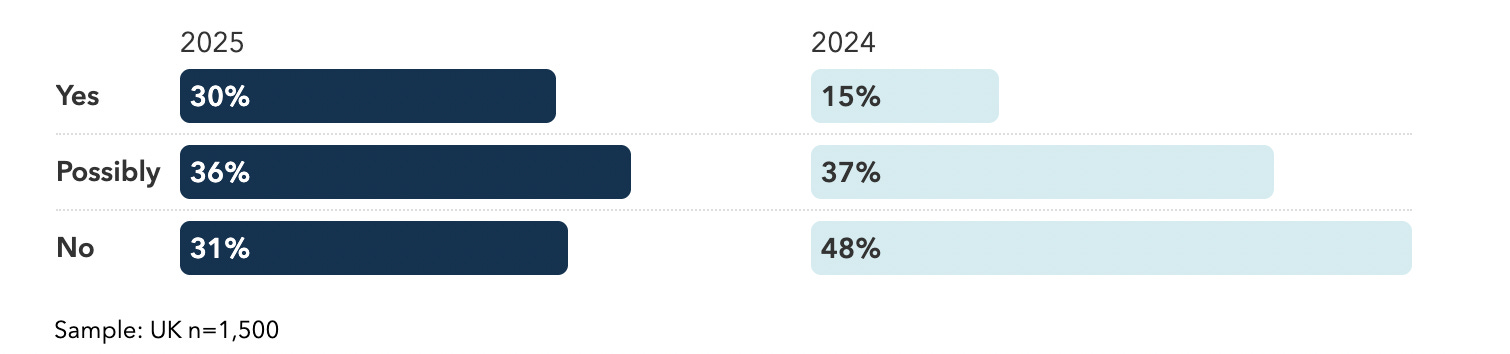
Entrepreneurship is suddenly looking a lot more attractive to British adults. According to a survey by QuickBooks, 66% of UK adults are considering starting a business or side hustle, an increase from 52% the year before. More interestingly, the share who actually intend to start one in the next 12 months has doubled to 30%. Almost half of adults surveyed say they earned money from a side hustle in the past year, and 45% of those people hope to turn it into a full-time business — though slightly more, 49%, are content to keep it as side income.
Is this a sudden surge in entrepreneurial zeal? Not quite. Respondents put starting a small business or side hustle top for potential returns next year on 26%, ahead of cash and savings (21%) and the stock market (11%). Only 13% think it is the riskiest of the options they were shown, below both crypto (32%) and shares (20%). Higher return and lower risk than equities is less a claim about entrepreneurship than it is a verdict on the alternatives.
The survey shows that earning more money is the single thing Brits say would most improve their satisfaction with life, outranking better health, relationships or more free time. Of those considering starting a business or side hustle, just over two-thirds would begin it alongside existing work.
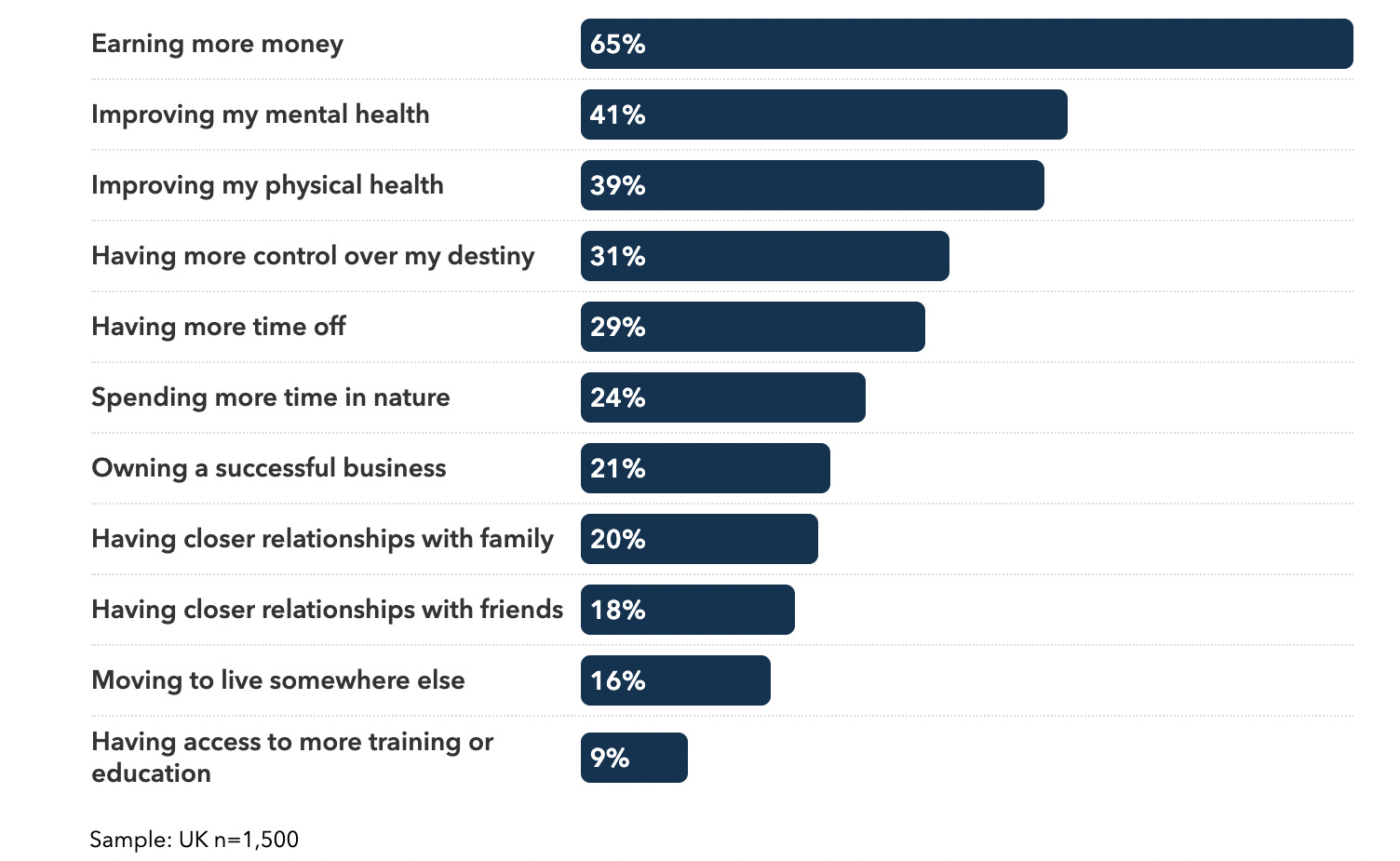
You’d expect a lack of ambition to be the biggest obstacle, but Britain may have more entrepreneurial ambition than it is given credit for. What stops people is a lack of money. Asked to name their single biggest obstacle, 30% said a lack of savings or startup capital, ahead of 26% who said fear of failure. Six in ten say they would be more likely to start a business if financial guidance were easier to access. Asked what would most help them feel ready to fund a business, 32% chose a small grant, against 12% for a clearer funding plan.
In The Entrepreneurs Network’s own recent survey of UK founders, Cool Britannia, a similar pattern emerged. According to respondents, the strongest signal that a country is serious about entrepreneurship was tax levels and breaks on 68%, followed by access to capital on 60%. As it turns out, aspiring founders and established ones are asking for the same thing — easier access to finance.