
Three Big Ideas #55
Home-grown metals, practical PhDs, and accelerating adoption of advances


Welcome to our fortnightly Three Big Ideas roundup, in which we serve up a curated selection of ideas (and our takes on them) in entrepreneurship, innovation, science and technology, handpicked by the team.

⏩ Eamonn Ives, Research Director
In the last few days alone, we’ve fielded a number of requests from journalists keen to know whether or not AI is having a discernible impact on Britain’s labour market. There’s certainly evidence to suggest that it might be, but the old adage of not confusing correlation with causation must be heeded. As I told both Bloomberg and The Telegraph, other factors — not least the increased tax burden of employing workers, plus new regulations that make it harder to fire underperformers — might hold more water for explaining the sustained rise in unemployment over recent months.
That being said, I think it’d be foolhardy to be too bearish on AI’s eventual impact on the world of work. A new working paper from Hemanth Asirvatham, Elliott Mokski and Andrei Shleifer gives credence to that hunch, and suggests change may occur quicker than we might expect. Their research studies how long it takes for various technologies to experience widespread adoption after being invented, and, crucially, how this has changed over time. What they find is striking — a tenfold decrease in ‘adoption lags’ since the start of the industrial age to today. Whereas it once took roughly 50 years for a technology to go from initial prototype to being diffused into the economy, it now takes only around five. While the authors do note AI has some properties that might somewhat slow its spread, they nonetheless believe there are reasons to believe its adoption will be rapid.
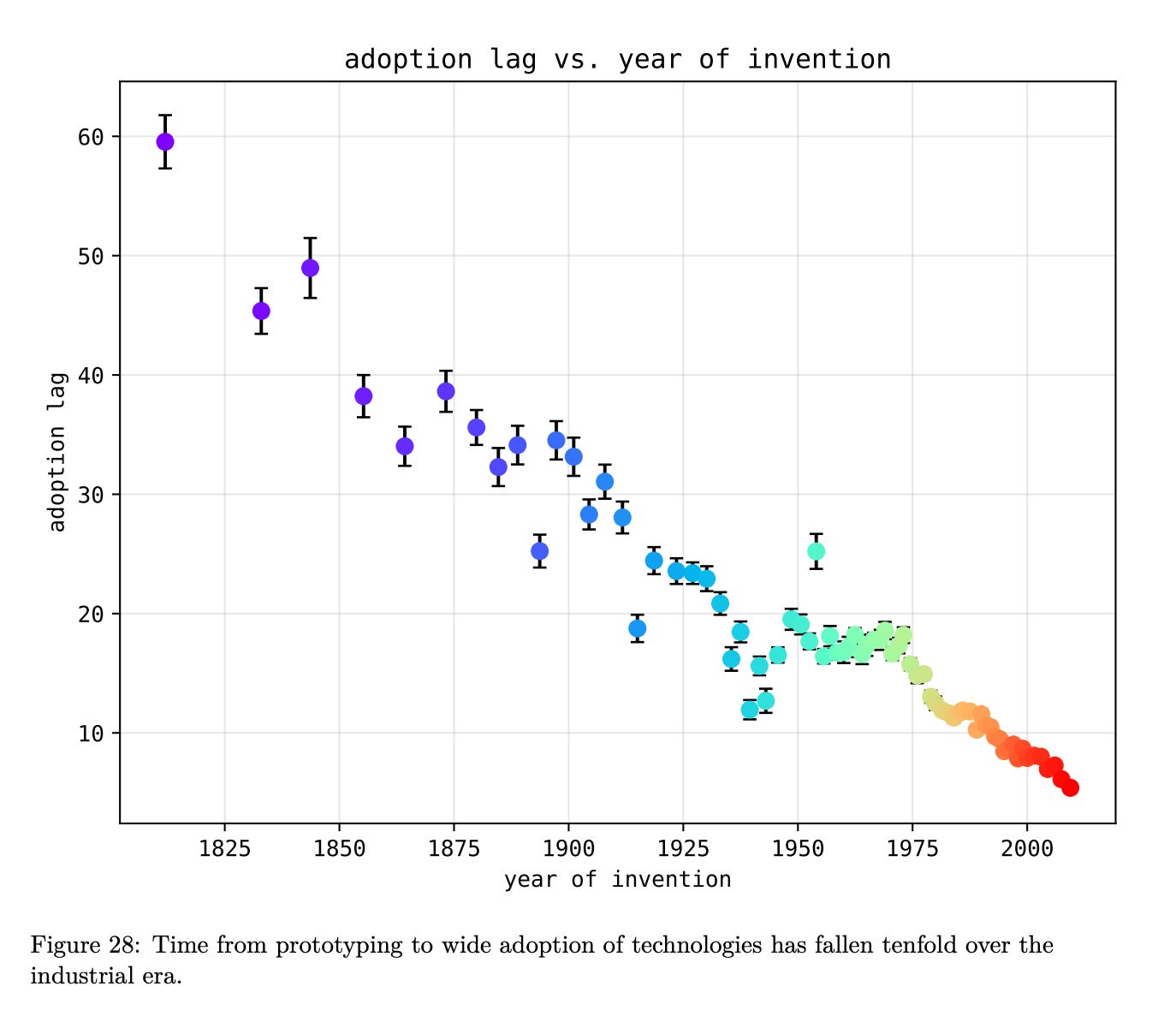
Nobel-winning economist Robert Solow once famously quipped that “you can see the computer age everywhere but in the productivity statistics.” If Asirvatham, Mokski and Shleifer are right, we might not be able to say the same about AI for much longer.
🎓 Mann Virdee, Senior Researcher
Here’s something to think about: since the turn of the millennium, the number of doctoral students has more than doubled globally and is increasing each and every year. At the same time, there is room for less than 20% of them in permanent academic positions. In some fields, it can be as low as 3–5%.
That is not necessarily a problem. It depends what you think the purpose of a PhD is. A Doctor of Philosophy is, after all, about a love of wisdom. My own experience is that a PhD helps one think more deeply and ask more searching questions. That’s undoubtedly a good thing in and of itself.
But there are other ways to engage with knowledge — and it’s clear too many people are going down the same pathway that doesn’t equip them for careers outside of academia. Surely there are other ways to pursue a love of wisdom that doesn’t require a highly specific route of writing and defending an academic thesis for the vast majority of PhDs who will never be academics.
China is responding with an interesting innovation: the ‘practical PhD’. In this new model, engineering students graduate by defending a physical product instead of a written thesis. Students have two supervisors, one from a university and one from industry, and must prove their inventions would work at an industrial scale. It’s different from an Engineering Doctorate, which still relies on a traditional write-up.
Critics who argue that this isn’t a real PhD have a point, but they are also missing the point. Our current system trains vast numbers of people to write academic papers who will not need that skill after completing their doctorate. So while we shouldn’t stop people doing PhDs, experimenting with contributing to knowledge in forms other than a thesis seems like an excellent idea to me.
As the Financial Times recently noted, the graduate premium is collapsing in the UK. The problem is not that we have too many graduates, but rather that our economy is failing to create the high-skilled, professional jobs. Unlike the US or the Netherlands, the UK’s share of managerial and professional roles has stagnated. We have a skills mismatch because our PhDs are trained to write papers, while our economy desperately needs them to build companies and infrastructure. Perhaps shifting the dial slightly will help us turn our oversupply of graduates into an engine for growth.
🔋 Jessie May Green, Events and APPG for Entrepreneurship Coordinator
We rely on critical minerals, such as lithium, copper and cobalt, for everything from smartphones to wind turbines. Energy, communications, defence, transport and scientific research all depend on their ready supply. Yet being a globally traded commodity, critical minerals are acutely vulnerable to geopolitical shocks.
To mitigate risk, and to drive up standards in this notoriously harmful industry, the Government recently released its ‘Vision 2035’ Critical Minerals Strategy. The report emphasises three key focuses going forwards: collaborating with international partners, improving the ethics of international markets through enhanced ESG, and expanding our domestic capacity. The last point is an interesting one.
By 2035, the Government aims to be sourcing at least 10% of the UK’s critical minerals domestically (with a further 20% from recycling products that contain them). The fact that we have this much potential may surprise those living outside of industry hotspots like County Durham and Cornwall.
Currently, most may associate the sector with countries such as the Democratic Republic of Congo (cobalt), Brazil (ferro-niobium), and China (lithium and others). Fewer may be aware that Cornwall holds what is believed to be Europe’s largest lithium deposit, or that the largest tungsten deposit outside of China is in Plympton, Devon. Due to a lack of recycling facilities, the UK is a net exporter of copper, despite our domestic requirements for copper projected to double by 2035 to meet our climate targets. This highlights a need for enterprise and innovation if we are to increase our domestic resources and bring about circularity in the sector.
Nationwide, it’s all hands on deck. From the Scottish Government’s Draft Circular Economy Strategy and the Welsh Government’s Beyond Recycling, to the Critical Minerals Challenge Centre in Exeter and this pioneering magnet recycling plant in Belfast — Westminster is not alone in its desire to make the critical minerals supply chain more ethical, sustainable, diverse, and secure. Hopefully, ambition will only increase, and we will see a regeneration of local economies in the UK’s mineral-rich regions, as well as dignity and prosperity for our international partners.