



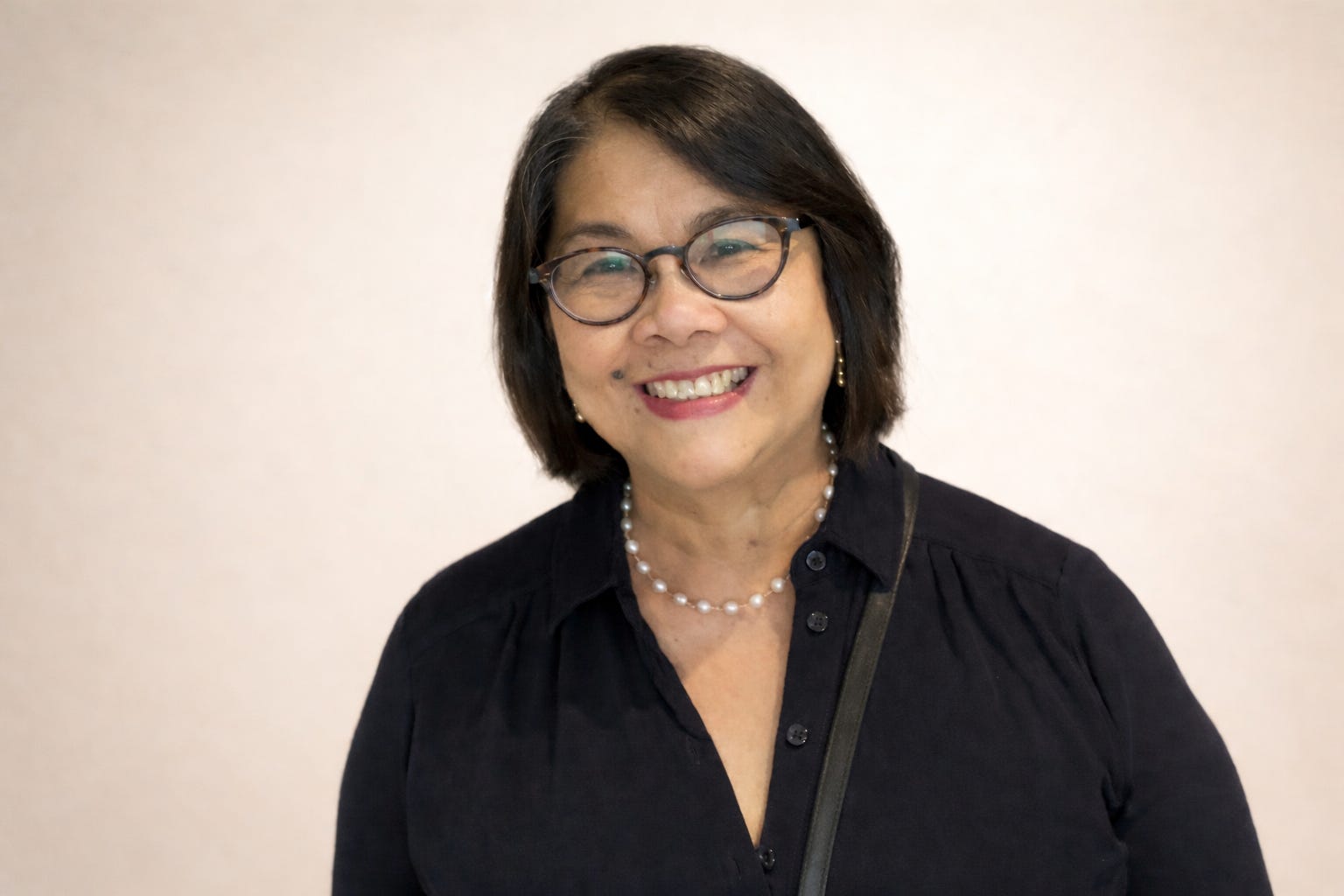
Grace Almendras-Castillo built a healthtech company in Toronto, raised most of its money from US investors and sold it to an American buyer. She could have stayed in Canada, where she had 30 years of relationships. Instead, she moved to the UK, where she knew one person, and started again.
The UK’s 5.5 million small businesses drew her in, and so did its finance sector, which she rates alongside New York and Singapore for rigour. Gifftid, the AI platform she’s since built, exists to help overlooked businesses get in front of investors, banks and corporates who could fund them.
Getting there, however, took work. Grace spent her first months in London entering rooms where nobody knew her name, letting the relationships build before she asked for anything.
It’s how she built her first company too — flying to Silicon Valley, New York, Boston and Chicago several times a month, convinced a founder had to be there in person to be taken seriously.
We spoke about what it takes to build in a market you weren’t born into.
What we discussed
Building Self Care Catalysts and selling it, and raising most of its money in the US.
Why she chose the UK to start again in her 50s.
Why she thinks founders have to be physically present in the market they want to grow in.
Why she thinks the funding gap for women is a problem of evidence more than bias.
Her advice to founders raising capital, and how to tell when you’re pitching the wrong kind of investor.
Lessons for policymakers
Judge small businesses on more than their accounts. A company’s accounts show whether it can pay its debts, and little else. So the things a founder does to keep the business alive — mortgaging the house, going years without a proper salary — show up only as evidence that they are a bad bet. Grace argues a bank could learn more from how a company operates than from its balance sheet. Financial institutions are not expected to change their current risk assessment models, but to curate more intelligence not typically included in traditional underwriting.
Open up data in the sectors that don’t have it. Financial platforms building a finance product in the UK can plug into open banking and other public intelligence. Grace had no equivalent in healthcare, where the data belonged to patients, every use required consent and nobody in the industry would share.
Lessons for founders
Be there yourself early on. You can hire a team who knows the market, Grace says, but at the start the founder has to turn up in person.
VCs aren’t the only route to capital. Angels, super angels, revenue-based financing, debt and grants are all legitimate paths, but people don’t always think — or know — about them early on. Choosing the wrong type of investor for your stage, Grace argues, is a common misalignment.
Match the investor to what you’re building. Investors have different theses, and Grace argues founders often read a bad match as a rejection. If you’re not offering deep tech or AI, Silicon Valley VCs aren’t interested.
The people who back you early are rarely convinced by your pitch deck. They invest because they trust you — your integrity, your track record of delivering despite constraints — and that kind of trust, Grace explains, is hard to convey on a slide.
The founding story
You built Self Care Catalysts in Toronto and sold it to Alira Health in 2022. How did that lead to Gifftid?
The thesis of Gifftid came from decades of work. I started in the corporate world, at some of the largest pharmaceutical companies, then became an entrepreneur with Self Care Catalysts. That gave me several vantage points. Inside a large company, I’d worked with small suppliers, decided where to invest our capital and set up joint ventures.
Afterwards I wanted to work on behalf of small businesses. Large corporations have capital, infrastructure and people. They also depend on small suppliers who have none of that, and who struggle to win a contract long enough to plan or borrow against.
What was the shift from corporate life to running your own company like?
Self Care Catalysts was a turning point. Coming from a cushy job, I had to learn how to run a small business — put my own capital in first, then raise more, then build teams.
I started with my own, my family’s small capital, then friends, then people who’d never met me and backed me anyway because they could see I was trying to solve something in healthcare. The hardest part was doing it on limited funds and hiring people yourself, with nobody to help you screen them.
You do everything when you’re a start-up — building the team, building the product, selling, commercialising — and you’re always raising.
What got me through was my team. It matters enormously to have people behind you who back what you do with capital or commercial contracts, and they do it because of your integrity and your ability to deliver despite the constraints. None of that shows up in a pitch deck.
From North America to the UK
How did being on the other side of that — a small business being judged by investors — shape Gifftid?
I’m Canadian and I lived in Toronto, but I raised most of my money in the US. I had some Canadian investors too, but I commercialised the company in the US and it was acquired there. It was the natural market for it.
My commitment to small businesses isn’t about a big market on paper. It comes from having been one, and from working with so many that deserve more capital and capacity — because they can use it.
Founders are the first to take risks. So when a bank turns you down and calls you high-risk — well, yes, but taking risks is the whole job. It runs from mortgaging your assets to going years without the salary you deserve.
Those risks don’t show up on a balance sheet — financial statements only read your ability to pay. So much about a small business is illegible to funders.
So I built Gifftid out of that conviction. First I found people who believed in it — some were classmates from Oxford’s Saïd Business School. They didn’t share my experience, but they had conviction and said, “let’s work with you on this.” Others were investors from my last company, or friends who backed me without quite knowing what I was building.
One day a major investor texted me: “Grace, can we invest in your company?” She was asking permission, without knowing what it was. She’s my biggest angel investor today.
None of that shows up in a pitch deck — and a deck is easy to assemble now, especially with AI. An investor or bank could learn far more about a company from other signals. That’s what we do. We gather public intelligence and operational signals that never reach a balance sheet, and turn them into real-time evidence for small businesses.
Why did you choose to build Gifftid in the UK specifically?
Moving here was a risk. I’m in my 50s, and I left Toronto — home for 30 years, where I had all my relationships — for a country where I knew just one person well: my former chief of staff.
I moved because the UK is willing to change how it deploys capital. First, it’s one of the most rigorous and respected financial centres in the world, alongside New York and Singapore. Second, it has 5.5 million small businesses — where else? — and a whole ecosystem around them.
One lesson from before is that you have to be present where you want to grow — build relationships, get out and learn. So I listened. I walked into rooms where I knew nobody, and I was lucky to always be invited. Sometimes I’d wonder why I was there; usually it was simply to listen and learn. That’s what the UK has given me.
Your first company took years to find its market. Is building faster now?
I tend to enter markets that don’t exist yet and help create them. Digital health wasn’t established when I started. I was one of its early builders. More than 200,000 patients were using our technology, until we pivoted to serving the pharmaceutical companies who became our customers.
It was slow partly because the market didn’t exist, and partly because I was challenging the system. In healthcare, patients used to be recipients of care, left out of treatment decisions. The power sat with doctors, hospitals and big companies. Only now is that shifting.
That’s why the company was called Self Care Catalysts. The whole idea was to give patients their own data and let them make decisions with it. It took a long time.
Healthcare is also harder because the data belongs to the patient. Using it means getting consent, and back then the ecosystem wouldn’t share. Compare that with open banking here, which is well established across the UK and EU — a completely different environment for new ideas.
Raising money in the US, though, is fast. I closed my first external round after speaking on an innovation stage in Washington, DC, about the technology we’d built. The technology took enormous time and money then. I could build it in a much shorter time now.
Here the environment is ready for new thinking, and the infrastructure for generating data is far better. Back then I was building my own very basic natural language processing. What used to be slow for lack of data is fast now — and it helps that I know what I’m doing this time.
Being present where you want to build and grow
What would you say to a founder expanding into the US who can’t be there?
You have to hire a US team — people who know the culture, already have the relationships and understand the business you’re entering. But if you’re really early, the founder has to be there.
Building my first venture, I was on a plane to Silicon Valley, New York, Boston or Chicago several times a month. It was easy, though, because I was based in Toronto.
One thing about the US is that once people believe in you, they say “I like you, I’ll introduce you” — and they do it straight away. You get picked up and brought around fast.
In the UK, I identified advisers who might be aligned with what we’re doing and reached out cold. They came on board, hugely committed, and have been introducing us across the ecosystem. That’s why I believe in finding people who believe in you. You don’t have to ask them to work hard, they just do.
Are there programmes on the US side worth UK founders knowing about?
Springboard Enterprises is an all-women accelerator that started before accelerators were even in vogue. They do everything to introduce you — booking meetings, putting you on stage, working for the founders. They brought us to Washington, DC, the White House and Silicon Valley. That was years ago, so I can’t speak for how it works now, and there are far more programmes today than there were a decade ago.
Here, I’ve deliberately not joined an accelerator programme because I already had so much experience, and I’d rather spend my time building and finding my own supporters. Whether that’s the right thing or not, I don’t know. But I’m happy with the progress we’re making.
Gifftid’s thesis
Who are the invisible entrepreneurs, in practice?
We’ve identified and named thousands of what we call the modern SME — smaller companies solving problems for society, whether in climate, energy, healthcare or food and agriculture.
Those are businesses traditionally seen as fringe or niche, but when we look at their forward-looking signals, they’re the ones with high commercial potential. The limitation is that they’re not given capital.
Immigrant entrepreneurs are the hardest to fund. With no starting point, you’re constrained on every side — capital for the company, building a new life, even the cost of attending events. But they’ve already moved to another country. They’ve been through enough hardship that the difficulty of building a business is easier to absorb.
Does the same logic apply to women?
The logic applies, but I’m probably one of the few who’ll say it differently. It’s not that investors don’t want to back women. It’s that there isn’t yet a long track record of returns to point to. Women only started founding companies in real numbers a few decades ago, so the track record investors look backwards for barely exists. That’s the gap.
Women tend to be very capital-efficient — we can do a lot with little — but those signals aren’t captured anywhere. There’s nowhere for them to be recorded. That’s what we’re building — the infrastructure to make those signals visible.
Women and foreign-born founders building companies that tackle climate, energy, healthcare or food — those are the modern SMEs. We’re the first to name them as such.
Advice and closing thoughts
What’s your advice for female founders on proving themselves to investors when the track record and evidence they’re being asked for might not exist yet?
It’s always a combination. First is economics, because when you’re talking to an investor, they need to make their money back with good returns. Investors have different lenses and different investment theses.
If you’re pitching to Silicon Valley VCs and you’re not offering deep tech, AI or something that returns at least 50x or 100x, don’t bother. Find the investor whose thesis aligns with who you are and what you’re doing.
Second, VCs aren’t the only route. I didn’t raise from them — I raised from angels and super angels, then borrowed against revenue once I had it. When I hear, “why does only 2 per cent of VC funding go to female founders?”, I’d say a lot of it is misalignment. You’re chasing a type of capital that doesn’t see you the way it needs to make its returns.
Third, be yourself. I never changed who I am, but I learned and got better. Still, respect that you’re there to ask for money and have to prove you’ll return it on good terms. If VC money isn’t the fit, look elsewhere — debt, grants, blended or revenue-based financing, or your own money first.
It’s not just about the money, either. You have to think about the nature of the capital you’re seeking and whether you can work with that funder at all. It matters most with PE and VC, because they have their own thesis, and you have to be ready to absorb that. Even after a first or second meeting, you won’t fully know who they are.
As a first-time founder I learned this the hard way. I thought doing good for society was enough, but you also have to show them when you’ll land your first million in revenue — that’s what earns a VC’s respect. If you haven’t got commercial revenue yet, don’t chase VC money. Spend the time building instead.
The number one thing: learn how to build and run your business, then pitch it.
What’s one thing you’ve read, listened to or come across recently that you’d recommend to readers?
This is going to be self-promotion, but I wrote a book called Boundless: Every Day. In Spite Of. It’s about how I made my decisions to get to where I am, and I’ve built an executive programme to go with it.
This series is run in partnership with the Jessica Vollman Foundation, a non-profit founded to honour the legacy of the late CEO, founder and advocate for women in entrepreneurship: Jessica Vollman.