
Built to Scale
Mollie Claypool on how AI and deployable robotics can break the deadlock of the global housing crisis



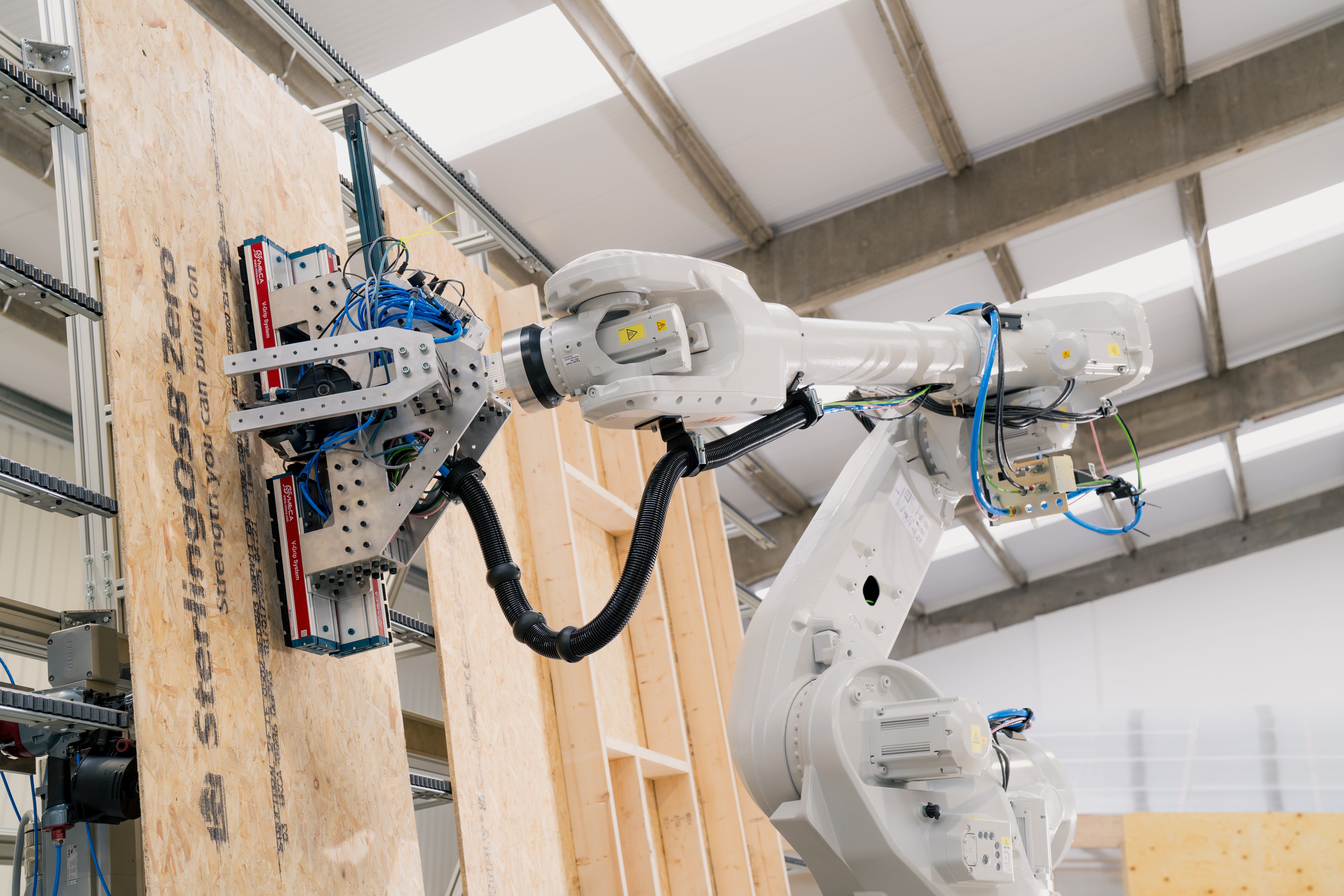
To say the United Kingdom has a housing problem would be an understatement. Our inability to build the right homes in the right places is nothing less than a national crisis. The implications show up most straightforwardly in higher rental costs and artificially inflated house prices, which keep people at the foot of the housing ladder for longer and longer. Wider consequences for society include weaker economic growth and stifled rates of innovation, as labour markets become less dynamic and agglomerative forces are suffocated. Beyond these, ‘the housing theory of everything’ convincingly shows how a host of other social problems — from inequality to climate change, and obesity to even falling fertility rates — can be explained by our inadequate supply of housing.
A litany of factors conspire to create Britain’s housing crisis, but one is a chronic shortage of skilled labour needed to actually build new homes. The housebuilding industry is grappling with an ageing workforce — where around one third of workers are now aged over 50. According to the Construction Industry Training Board, the UK needs an additional 250,000 construction workers by 2028 just to keep pace with rising demand.
Britain is not alone in its failure to increase its housing supply. Numerous capital cities and other major urban areas in every corner of the globe suffer from the repercussions of low housebuilding. According to UN-Habitat, nearly 100,000 affordable homes need to be built every day to house the roughly 3 billion people who will need adequate housing by 2030.
It’s clear something needs to change.
Mollie Claypool, Co-Founder and CEO of AUAR (Automated Architecture, pronounced ‘our’), believes the solution is to change how we approach housebuilding. While the automotive and aerospace industries embraced automation decades ago, building a home remains a fragmented, unpredictable and labour-intensive process.
Rather than forcing builders to navigate high capital costs and the logistical nightmares of traditional off-site manufacturing, AUAR brings the factory to the building site. By integrating Physical AI (AI systems that operate in and interact with the physical world) with robotic micro-factories housed in standard 40-foot shipping containers, AUAR is attempting to turn construction into a predictable, software-driven service.
The goal is a huge reduction in friction. Through their ‘MasterBuilder’ software platform, AUAR automates the translation of architectural designs into robotic instructions, allowing mid-sized builders to produce high-performance timber frames on-site with a fraction of the traditional crew. If AUAR succeeds, they will not only lower the cost of housing but also provide a blueprint for how hardware and software can combine to solve real-world industrial bottlenecks.
I caught up with Mollie to discuss the mechanics of the robotic micro-factory, why the UK needs to shift from simple subsidies to sophisticated procurement, and why the most important step for any deep-tech founder working in the physical environment is to move out of the lab and face the real-world environment from day one.
What we discussed
The transition from centralised off-site manufacturing to deployable, on-site robotic micro-factories.
The synergy between AUAR’s MasterBuilder (the software brain) and the MicroFactory (the robotic muscle).
How AUAR achieved a validated 30% cost reduction across 150+ feasibility projects.
The collective action problem in the UK’s housing market and how government procurement can break the deadlock.
Lessons for scaling deep-tech construction companies
For policymakers:
Address the collective action deadlock. Both the private and public markets are waiting for someone else to take the first risk. The government should break the deadlock by acting as the first sophisticated customer to prove the viability of distributed manufacturing at scale.
Align grant cycles with startup velocity. Public funding in the UK often suffers from a timing mismatch. Faster tranching and more upfront disbursement are critical for hardware-intensive startups that cannot afford long lag times.
Incentivise regenerative productivity. Link housing subsidies not just to the number of units built, but to the productivity of the build. For example, offering tax breaks to builders who achieve a specific units-per-labour-hour metric encourages the adoption of innovative approaches.
For founders:
Prove by doing in the real world. Don’t rely on controlled lab environments for your proof of concept. Take your technology into live, messy, commercial conditions from day one. Real-world friction exposes assumptions that labs never will, and makes it easier for investors to see its viability.
Balancing strategic opacity and transparency. While there are reasons to be wary about sharing too much information about your product, the hardware should be as legible and non-threatening as possible. Using industry-standard components builds immediate trust with insurers, regulators, and conservative customers who are wary of black box proprietary hardware.
The advantage of multi-disciplinary teams. Bringing together people with diverse skills and expertise is a prerequisite for success. In deep tech, a team of software engineers is often blind to the physical realities of the site, while a team of traditional builders is often blind to the potential of automation.
Full interview
I. Building the Micro-Factory
Could you explain what AUAR does, who uses it, and why it matters?
AUAR builds physical, deployable, robotic MicroFactories and MasterBuilder, a physical AI software platform. Those two things together allow home builders to produce timber-frame walls, floors, and roof elements on-site without having to build or buy a factory, or buy panels from manufacturers.
The MicroFactory sits inside a 40-foot shipping container. It can be deployed in a day — that is, going from being delivered on-site to starting production — and it plugs into the 3-phase power supply that’s available on-site or provided by a generator. Our customers are charged only for what we produce on a per-square-metre basis.
What that means is that there’s no capital expenditure for builders. There’s no operational expenditure because we provide a MicroFactory production manager, and there’s no need for a very long-term volume commitment because they only pay for it when it’s producing panels. We work with mid-sized, regional home builders across the United States, the UK, Europe, and Canada who want to add automated production capacity without having to transform their business model or their operations.
Why this problem, and why now?
The pressure is coming from all directions, all at once. We have labour shortages that are chronic and getting worse. Across the UK, Europe, and the US, we need 3.7 million workers to meet housing needs. On-site crews are very hard to find and very hard to keep, particularly outside of major cities.
Additionally, the UK’s Net Zero target is adding material requirements and performance standards that manual construction struggles to meet. On top of that, housing demand shows no sign of moderating; it’s continually increasing because there’s been decades of under-supply and increased urbanisation.
We’ve been building the same way for a hundred years, but what’s changed is that the risk of not acting right now is higher than the risk of trying something new. Builders who can’t deliver faster and more cheaply are going to lose the ability to build at all because they won’t be able to keep their businesses afloat. It’s an economic sustainability problem, and governments that can’t unlock new delivery models also aren’t going to hit their housing targets. For us, the timing means we’re entering the market at the exact moment when the adoption barriers are coming down because of increased accessibility of industrialised automation.
How does that look in terms of numbers? How many people are needed on-site compared to manual construction?
It would take a timber framing crew of four to eight people, depending on the size of the house and their skill, up to eight weeks to build the core and shell of a house. With AUAR, it takes one day to produce all the elements of that house, and then a couple of days to install them with a very small crew of two to three people.
II. The Muscle and the Brain
What is uniquely hard about what AUAR is doing compared to traditional modular factories?
The hard part of what we’re solving in comparison to a traditional factory model is the deployment model itself. A traditional factory requires builders to send their designs to an off-site manufacturer, wait for production, and pay for the transport of those finished panels. That has a logistical radius where it becomes financially viable. It also means builders have to wait to be put in a queue or they have to own the factory themselves — which increases their risk exposure through very high capital expenditure and operational expenditure. Essentially, the logistics cost, the coordination overhead, and the mismatch between factory schedules and on-site work create a lot of friction.
Are there any metrics you’re particularly proud of?
We’ve validated that the cost reduction across the 150+ projects that we’ve done feasibility analysis on over the last 18 months is 30%. That’s a 30% saving on the timber framing package costs against what builders are currently paying.
Do you build your own robotics hardware, or is what you’re building primarily the software brain, MasterBuilder?
We’re building both hardware and software, but the framing matters here. We have built a proprietary MicroFactory, which is a hardware system, but we have chosen to not develop our own industrial robot from scratch. We use an ABB robot — the same kind found in automotive manufacturing — but that sits alongside a custom-designed, patented robotic system that can work non-linearly across multiple processes – cutting, assembly, calibration, routing – allowing for increased throughput, real-time control and the production of any kind of panel a design requires.
ABB has been a strategic partner for us since 2022 and an investor since 2023. Ultimately, our strategic decision was: don’t compete with the companies that have been building robots for 70 years. Focus on what’s genuinely novel, which is system integration, assembly mechanics, and software that makes the whole thing usable without an army of manufacturing engineers, and the operating model around it. You can’t separate them: the MicroFactory is the muscle and MasterBuilder is the brain.
Is there a common misconception about robotics in construction that you’d like to retire?
I’d like to retire the perception of robotics as inaccessible or that it means you have to make huge changes to how you run your business. With us, it’s the opposite. It’s a way to add production capacity when labour and cost risk is the limiting factor. Their workflow stays the same; the panels we produce are already a line item in a builder’s procurement package, and the panels are still installed by their site crews. But the manufacturing step and the data builders need for their operations is automated and predictable. They don’t need to hire robotic specialists; we deploy it, we run it, and they keep building.
III. Navigating the UK’s hardware landscape
How do you view the UK’s hardware landscape as a startup founder?
Access to public funding in the UK is one of the more difficult challenges as I see it. I think it’s also very difficult to access venture capital funding from UK-based investors. There’s a lot of sophistication in the UK around software — investors understand growth, scale, and recurring revenue. But for us, we are hardware, which is a very different conversation. Development cycles can be longer and the capital requirements are higher.
There’s a risk aversion in the UK’s startup ecosystem around funding hardware. Now, we found investors who genuinely understand that the most defensible software businesses are ones where hardware helps create the data moat. You can’t build MasterBuilder’s data without deploying and running micro-factories on real site conditions. But that insight isn’t universal across the funding landscape.
While we’ve benefited from grants — we had an Innovate UK Smart Grant that’s enabled us to develop and expand our market reach from low-rise to mid-rise housing — what we’ve found is that the timing has a bit of a mismatch for a startup. Grant disbursements can lag behind our cycles. You need either much more upfront disbursement or faster tranching.
If you were advising the Secretary of State for Housing, or Science, Innovation and Technology, what should the Government’s top priority be?
Stop waiting for the market to lead on this and use the levers government actually has. The labour shortage in construction isn’t going to resolve itself and climate targets can no longer be met by incremental improvement.
The government can use public housing programmes to encourage, for example, the use of industrialised automation and regenerative materials. They could encourage the use of distributed manufacturing. What that would mean is they would create the demand signal that gives builders the confidence to make the jump. I think the private market and the public market are stuck in a collective action problem — everyone is waiting for someone else to go first. Government should break that deadlock.
IV. The Founder’s Journey
Tell me about the journey of AUAR. How did it come about and what has the process been like?
I have worked with my Co-Founder and CTO, Gilles Retsin, for 11 years. We’ve worked at the intersection of architecture, manufacturing, robotics, and construction for our entire careers. We previously ran a research lab at UCL looking at how to develop new design methodologies for construction using automation. That lab was a founding think tank for us. From that, we won grants to build physical prototypes, which then attracted industry interest. We set up AUAR as a consultancy first to leverage that interest, learn from the industry, and bootstrap the business while we built our own product.
Gilles is an architect and technologist with a unique ability to understand design and automation from a product perspective. I come at the problem from a first principles, systems-thinking point of view. Together, we aren’t just looking to enable the industry to create good homes, but to productise the entire system.
In our team, we have a senior leadership who have scaled companies from 40 to 400 people before. Our COO, Bridget Hipwell, was Head of B2B Customer Success at Zego and has a manufacturing engineering degree from Cambridge. Our US growth lead was the COO of a regional home builder — exactly our customer profile. Our Head of Robotics was leading Rolls-Royce jet engine production for years. The important thing is we look for people who aren’t siloed in their thinking, who are agile and proactive in taking on the problems that will unlock the next stage of the business.
How has the recent explosion in AI capabilities changed how you function as an organisation?
Everyone in our team is finding operational efficiencies because of AI. For me, as a non-technical founder, it has given me the power to synthesise knowledge that exists in other members of my team much more quickly. It has also given us the ability to create very tight and efficient feedback loops between sales, product, and customer success. One person can now be 10 people in a week, and as a result, our velocity has increased exponentially.
We are a software-enabled hardware business, and we’ve always been fast in terms of hardware iteration, but we’re getting faster and more ambitious because organisationally we’re so much more operationally efficient.
What is your final piece of advice to founders building in this space?
Our attitude has always been: prove by doing, which means work in the real world from day one. Don’t do a proof of concept in a controlled lab environment. Do everything as though it is the scalable product that you will sell everywhere. Take something out into live construction environments with real customers under real commercial conditions, because those conditions just expose every assumption you have about your technology in ways that you can’t uncover otherwise. Your technology gets much more robust, much more quickly.
What is one interesting thing you’ve read or listened to recently that you want to share with our readers?
I’ve recently discovered the Centre for British Progress as I shared the stage with one of their founders recently at TxP’s Scaling Robotics event. Their research unpacks and demystifies much of the public narratives around what is really holding back the UK from progress. Their recent Substack post, “How we unleash Cræft Britannia”, is a good entry point (not least because they have announced a £60,000 prize for inventors that are pushing the boundaries of what is possible!).